Showing posts with label Nutrition and Diet. Show all posts

Saturday, 27 February 2010

Battling the Coffee Demon

I’ve always been good at stopping things others appear hopelessly addicted to.

In 1996 I gave up smoking with scarcely a glance back; and when I became interested in nutrition about 8 years ago, I systematically removed foods from my diet with ruthless, almost mechanical ease. Sugar, salt, cereal, tomato ketchup, cheese – I just kept going until everything bad was eliminated from my diet. It didn’t matter how much I enjoyed them – I just stopped eating them.

My friends regarded me with amused suspicion. Was this guy human?

At some point during by diet clampdown, caffeine came under the hammer. I think at one stage I went at least 2 years without any caffeine from any source. I drank a lot of herbal tea.

So it came as quite a surprise in the last two months when I developed a caffeine problem I seemed unable to kick.

Regular readers will know that I tend to binge (for example.) I am pretty strict most of the time, but occasionally lapse in spectacular style. Granted, the gaps between binges last year were rather close together, but even at 6 weeks apart, I like to think the net health outcome was better than the steady drip-drip of a moderately unhealthy life.

It started at Christmas, during one of my ‘lapses’. I’d had coffee before during lapses, but for some reason, this time was different – this time I came to truly appreciate the ritual of making real coffee, its taste, sharing it with others and filling the house with that rich aroma.

Back at work in the New Year, a colleague offered to buy me a coffee. Christmas binge over, I should have said no – but I didn’t. As it happened, it was a particularly strong coffee, so bam – I was wired. I got more stuff done in three hours than ever before; and it felt great.

A few days later, I discovered how easy fasting can be with the help of coffee. A strategic cup at 11am more or less obliterated the appetite for the bulk of a 24-hour fast; it also gave me something to look forward to during the first few hours of the day when the long day ahead without food seemed a little daunting.

For a while I alternate-day fasted with ease, when normally I would struggle after a few days.
I started to enjoy the coffee-drinking rituals I’d established with my colleague, and the caffeine-fuelled meetings at which we’d seemingly cover way more ground than normal. When I felt tired at work, either because of a particularly savage gym session or because I had not slept well, I would have a coffee. Brilliant! I must have upped my productivity by 25%.

You get the picture.

It didn’t take long for the honeymoon to end. First, I quickly re-learned the 12pm rule – drink much coffee after that and my sleep was affected. I would sometimes drink two cups instead of one, and the energy and focus would metamorphose into a fidgety anxiety which, paradoxically, affected my concentration.

My response to coffee began to vary and it became a lottery how I would feel. If I drank coffee every day, the caffeine hit diminished so that even throwing back a large one didn’t have the same effect. Sometimes I’d get the nervous adrenaline and mild muscular tension but none of the benefits. Once or twice I found myself thinking “I wish I’d skipped that coffee. I just want to feel normal.”

The fasting benefit also diminished. The coffee still helped, but not as much. Hunger started to slice through the superficial caffeine lift, reminding me that I was fasting more often than is normally comfortable.

Curious to understand what I was doing to myself, I read this article on Fitness Spotlight. Apparently, caffeine stimulates our adrenal glands. It manufactures a physiological stress response. Done regularly, that cannot possibly be good. Everything I read told me it was a bad idea to drink coffee every day. So I decided to stop.

Four weeks later, I was still on the merry-go-round. Several times, I had given up for a few days, then re-started. I’d invented rules, re-written rules, made and broken promises to myself and explored just about every self-motivation approach I knew; but it hadn’t worked. My weaving, dodging and self-deceptive chicanery had inexplicably sabotaged my normally iron resolve.

First, I rationalised that I should moderate rather than give up, clinging onto the idea that I would be able to simply have coffee occasionally. “I’ll treat myself to a coffee on a Friday” and “I’ll only have coffee on fasting days” were two of my favourites.

Ever present was the phrase “Life’s too short”, an irritating mantra that had been plaguing me since last year, regularly whispered in my ear by that the little horned fella at all the wrong moments. This single, corrosive idea led to defeat after defeat in these inner skirmishes, and I would find myself once again over-caffeinated mid-afternoon, less than 24 hours after I’d sworn blind I’d never drink another cup.

Then, a couple of days ago, something suddenly when "pop". I’d had a terrible night’s sleep and was fasting. I’d also done some sprints in the morning, which as the day progressed added to my fatigue. Everything cried out for a double espresso.

The night before I had decided that enough was enough. Nothing unusual about that – I’d given up coffee at least a dozen times already, so no reason to think it would work this time. Except that on this day, when I went through the all my usual rationalisations, excuses, rule re-inventions and psychological self-trickery, none of them seemed to work.

The fact was, I’d got sick of bitching to myself about it. I’d worn myself down. The message had finally got through.

There were particular buttons I’d been pushing which I think had the most powerful effect. I had been saying to myself:
  1. “This is what makes you who you are – you can just top things,” – so failure threatened to strike at the very heart of my identity
  2. “You don’t have a right to get what you want all the time” – something patronising I often say to other people so it resonates strongly when directed at myself: I don't like being a hypocrite
  3. “Hyping up your system on a daily basis like this is chipping away at your health,” – this threatened to sabotage the supposed health advantage of my ‘strict then binge’ approach.
Finally – I started writing this blog post. Let’s face it, I will look like a tool if I trumpet my success then mess it up.
... Read more

Tuesday, 16 February 2010

A Hymn to the Lifestyle: Part 2 - Pseudo Paleo

In part 1, Paleo at its Best I waxed lyrical about the joys of being 100% tuned into the Paleo lifestyle.

A couple of years ago I went for months on end without a single lapse; but last year, thanks in no small part to a seemingly endless procession of celebrations that demanded full immersion, I fell off the wagon often enough to understand the profound differences between Paleo at it's best and 'Pseudo Paleo'.

Not Breaking the Emotional Food Ties

For me, Pseudo Paleo is characterised by a failure to emotionally let go of non-Paleo foods. This recent article on PāNu makes the point well. Kurt talks about the culinary alchemy with which we try to approximate non-Paleo foods using ingredients which, taken in isolation are each technically Paleo.

A good example is my recipe for Paleo/Primal chocolate, posted last summer. It seems highly unlikely our ancestors had the time, materials or inclination to process, assemble and create the ingredients for those chocolates - especially since they could spend a fraction of the time preparing just as tasty (in a different way) at a fraction of the energy cost. Survival is, after all, about the trade-off between the energy required to acquire and prepare food and the energy it provides.

I have no evidence that these pretend Paleo foods are less healthy in any tangible or immediate way; but what they do to me is much more insidious - they maintain the emotional ties with the non-Paleo equivalents. I may be eating chocolate made from concentrated coconut cream, cocoa powder and dried blueberry, but I am thinking about real chocolate.

Junk Food Stand-Ins and Impostors

As I mentioned in Paleo at its Best, when I am truly Paleo, I genuinely relish eating nothing but meat, vegetables, eggs, fish, nuts and seeds. The powerful emotional associations formed in childhood (I talk more about that here) fade away and I am utterly content with the joys of real food. That joy takes weeks to develop and is sabotaged when I instead seek pleasure from junk-food stand-ins and Paleo impostors.

Dodgy Digestion

In fact, concentrated versions of technically Paleo foods are my main weakness. When I am in Pseudo Paleo mode, I keep jars of tahini, and nut butter in the house, along with bags of almond powder and dessicated coconut. I routinely plunder these stores after a meal, eating large spoons full at a time and returning several times. My nut binges, too, take on a new dimension, ending only when the reality of my stomach's disquiet becomes clear, after which I invariably spend the night in mild gastric discomfort.

Hunger Control

Hunger control is a crucial part of being truly Paleo for me. Low-carb eating and especially Paleo eating give you a better chance of responding to your appetite the way nature intended... but in my experience, Pseudo Paleo foods inflame the appetite in a way that truly Paleo foods do not.

Admittedly Pseudo Paleo foods do not inflame the appetite as badly as real junk food - but they inflame it nevertheless. When I am in Pseudo Paleo mode, I cannot let go of the idea that each meal is an opportunity to guzzle until I am more than satisfied. True Paleo meals don't lend themselves to gluttony - overeating meat and vegetables feels counter intuitive. Overeating nut butter is supernaturally hard to avoid.

In pseudo mode, I seek smoked fish and salted meats; supermarket-sold pre-cooked chicken with its perplexing additives are something I become fixated with. I find that foods laced with these flavour enhancers, despite technically adhering to the low-carb and broad Paleo ethos, play havoc with my appetite.

Fasting Debt

In Pseudo Paleo mode my fasting works in reverse. I am always playing calorie catch up. I skip meals because I gorged on half a jar of tahini the night before, not because it feels like my body would benefit from a fast and I would like to emulate the experience and benefits of temporary food shortage.

I feel like one of those guys who always owes money. Instead of earning my meals with activity and fasting, I am paying for them with interest by skipping planned meals and going for unnecessary walks around the block.

Taking the Easy Way Out

Finally, I take the easy way out more often than I feel I should.

Instead of following through with a planned, savage, painful workout, I may move it to another day. Perhaps I had a bad night's sleep or decide my body needs a rest. Clearly there is a line to be drawn between what is sensible in a stressful modern life, and the need to buckle down and take the pain so that at other times you appreciate the easy life. In Pseudo mode, I stray too far from that line into easy street.

Then there's the coffee fasting. A 24-hour fast is a cinch when you load up on caffeine - at least that's the effect it has on me. Part of the value of the fast is to experience the hunger. I see coffee as cheating and find the evening reward is diminished when in Pseudo mode I resort to it.

And finally, cold showering, that paragon of the discomfort model - of how exposure to fleetingly uncomfortable stimuli can help you cope more easily with the milder discomforts of day-to-day life. In Pseudo mode I find reasons to shorten the cold section at the end of my shower, or avoid it altogether. I lose the resolve and the appreciation of the payback.

Identity?

In my case there are factors at play relating to identity, pride and control. Everyone, I am sure, is different. It's possible that some of the elation and well being I talk about in Paleo at its Best are diminished in Pseudo Mode partly for psychological reasons. It's in my nature to be 'all or nothing' and I love to evangelise. No doubt these are important to my identity and my state of mind plays a part in my perception of overall health.

But enough psychobabble. The fact is that most of the time I am not in Pseudo Paleo mode - and just now I am at the right side of a good 6-week run. Bit too much coffee, but otherwise good.

You Decide

The joys I talked about in Paleo at its Best are not easily earned - last year all it took was one week out of every six in Pseudo mode to strip away much of the buzz. The only way to find out whether Paleo at its Best is worth the extra effort for you is to put in the work required to get there, then decide for yourself.

A Hymn to the Lifestyle - Part 1: Paleo at its Best
... Read more

Sunday, 31 January 2010

A Hymn to the Lifestyle: Part 1 - Paleo at its Best

Lately I've realised how much difference to how I feel the level of Paleo adherence makes.

I always knew others chose their own interpretation, but until I'd experienced it myself, the implications were not clear.

From 2007 until early 2009 I was, with the exception of one or two spectacular lapses, pretty much 100%. Last year, things went a little awry.

To some extend inspired by Dr Dan's recent fightback on At Darwin's Table, I thought I'd tell you what I've learned. In part 1: Paleo at its Best.

At its best, it can be transformational. When I am 100% dialled into the Paleo/Primal lifestyle, there are days when I feel fantastic.

Mentally, I am alert and able to think clearly - some of my most inspired and productive moments at work have come on days like this.

My digestion feels brand new - it's as if I've outsourced digestion to someone else, such is the low profile kept by my innards. Intestinal wind seems like a distant teenage memory, like acne or warts. When the need for ablution comes, it does so expectedly, regularly and takes place with such effortless routine that I feel like calling a friend to celebrate.

I feel fit. Not just in a raw, VO2 max sort of way, but in a rounded way. My exercise sessions are brutal, but brief and functional - mainly bodyweight, sprints and swimming - things that feel like they have a purpose. I find myself semi-consciously tailoring the frequency, variety and setting to match a vague notion of the kind of environment I was built to exist in. This is not romanticism, you understand - simply an objective analysis of the most appropriate way to behave if I want to be in tune with my genes.

My joints, muscles and tendons are free from significant stiffness and feel ready to take on a range of demands. When I'm walking to work I look out for tree branches to briefly swing from or steps to jump up to or down from. I almost clutch at the ground with my Vibram Five Fingers, seeking uneven areas on which to relish the stimulus and gain extra traction with the toes.

Elsewhere, the sense of power over my environment is heightened by uncomfortable experiences I happily put myself through. I quickly learn that to feel truly comfortable in my environment I need to experience some hardship. I start my showers cold, moving to hot water only after 30 seconds, then finishing with another 30 seconds of cold at the end. Sometimes I have an opportunity to swim in the wild, where the more extreme cold makes the shower seem like a breeze; it's no fun.... but it is fun, because when it's over, I feel more alive than ever.

Hunger, satiation and my body's hormonal balances seem to be in perfect harmony. Again semi-consciously, I regulate my eating to reflect the imagined availability of food to a hunter gatherer.

I eat more on workout days, because it feels instinctively right. I go into sessions a little hungry and emerge with the righteous appetite of the successful hunter. I spend more time hungry than not. This feels right. I earn my food. I eat slowly, savouring every mouthful.

There's nothing on my mind but the Paleo fundamentals. Animal and vegetable. I fall asleep thinking about roast chicken and daydream about slow-cooked tongue with steamed vegetables.

My mindset is so fundamentally Paleo that overeating is scarcely an issue... and my hunger is so in tune with my requirements that even when I do have a hearty meal, I skip the next one without thinking about it. Once, twice or even three times a week I throw in a 24 hour fast, dealing with the mild hunger with total control - not a cross word in sight. I look forward to dinner, yet do not crave it.

I feel lean, I look lean. I box in front of the mirror. I look stupid, but I feel great.

I get tired early when it's dark, and in the morning I wake up early. My mind is alive with ideas. Sometimes I don't get enough sleep and feel tired - but one day in three I sleep like a log.

I imagine this is how I was meant to sleep. I console myself that whilst modern man may have the luxury of being out like a light for 8 hours, maybe sleeping light, alert for danger, is the truly Paleo way. I learn to function happily on the bad days after poor sleep because I know that on the good days I will be stalking the modern landscape like a panther.

Zzzzzzzzt!...sound of needle scratching off record.

If only this were the reality. Yes, I have achieved Paleo at its best for months at a time; but I have also, especially recently, spent months at a different level. The irony, of course, is that the knowledge of what could be sullies what is. Many would kill to feel as good as I do at the moment; but having felt so much better, I am not impressed. It's not that I don't do everything I described above. I just don't do them all at the same time...

A Hymn to the Lifestyle: Part 2 - Pseudo Paleo
... Read more

Monday, 11 January 2010

Making the Most of Animals: Part 3 - Beautiful Bones

[Click on the small pictures in the main story to see larger images]

In part 1 I talked about the value of offal and in part 2 about the value of fat.

In both cases these often discarded treasures are much healthier from animals that have lived a happy life; and although organic, free-range meat costs more, eating rather than discarding these parts can compensate for the additional expense.

In part 3, I am going to tell you about the value of bones. There are three opportunities: making soup from leftover bones, eating what's inside the bones (marrow) and eating the bones themselves.
Soup
This applies to smaller animals that can be roasted in the oven. Theoretically I suppose it applies to any animal but since we lack the facilities to spit roast entire hogs, I have no experience with using bigger carcasses in this way. For us, it applies to duck, chicken, rabbit and other poultry such as pheasant or partridge.

At the end of the meal, even the most determined carnivore cannot strip the bones of every morsel of goodness. Believe me I have tried - Mrs M sometimes finds me hunched over the dessicated remains of a roast chicken, mouth and lips surrounded by meat and grease, speculatively gnawing in search of some overlooked morsel of meat.

Here's what we do. After we've used all the easily available meat, we take what's left - usually a collection of bones or a semi-dismantled carcass - and cook it for several hours. I also include the leftover bones from our plates. This may seem unhygienic given we have been chewing on our respective bones - but they are going to be blitzed for hours, so it really isn't.

We break up into smaller parts any pieces that can be, then put them into the slow cooker. The idea is to add just enough water so that the pieces are covered and will remain covered as the water evaporates. We find an extra inch of water is usually enough when we cook overnight.

You can also simmer the pieces in a pan on the stove - but Mrs M was always nervous about leaving a pan on the stove overnight so using this approach we rarely cooked the bones for more than a few hours before bed. This is not really long enough to fully loosen the meat and (as we will see later) soften the bones. With the slow cooker it is easier to set the heat low enough to make overnight cooking appropriate; and it allays Mrs M's fears because slow cookers are self-contained and designed to be left in this way.

To make the soup you could simply sieve the hot liquid and make the soup from that - but you'd lose a lot of the good stuff, in my view. Instead, we first let the contents of the pan cool. Then I methodically remove the bones and gristle with my hands, ensuring we get all the little pieces of meat not already separated by stirring. This can be fiddly, but ultimately it's rewarding. You usually get a few crunchy bits and pieces in the last two spoonfuls of soup, but that's okay.

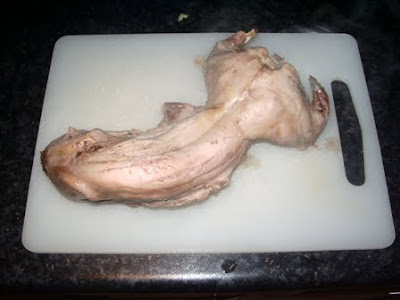
Here are some photos taken when we made soup from rabbit bones. This was the cooked rabbit: . After the meal, these were the bits left to slow cook , and this was the result after several hours of slow cooking with some stirring to separate the meat from the bones: . These were the bones I picked out and this was what was left . Finally, after some additional ingredients, the soup: . This is how those ingredients are added:
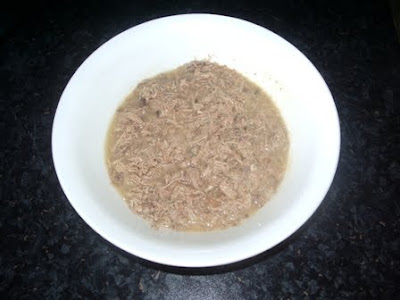
First, I steam some vegetables. Typically this is celery, onion, mushroom, carrot, parsnip or a combination. Once softened, they are added and blended into the mixture. As well as adding flavour, the vegetables thicken the soup - this is particularly important since thin soups are somehow not satisfying, yet the normal thickening agents like corn flour are not on the menu.

Next I add one or more of the following:
  • Coconut water (if I've just opened one)
  • Coconut cream (from a tin)
  • Unsalted tomato puree (we almost always add at least some - it's a good salt substitute)
  • Lime/lemon/orange juice (squeezed from the fresh fruit)
You can see some of this in action with these photos from a wild duck we ate last year. This was the duck after roasting and this was the meal it made . This was the leftover carcass and these are were broken up pieces in the slow cooker . After slow cooking and manual bone removal, these were the separate components: . The contents of the bowl went into a pan and while that heated up an onion was chopped, steamed and added . This was blended and some tomato puree added . In this case, I added the coconut cream cold , threw on a basil leaf, and it was ready to serve: .

When we roasted a chicken last year , creating this fine meal , there was this leftover carcass which went into the slow cooker like this , came out like this , and ended up making a couple of bowls of this: . I think we actually used spinach in that case.

It's usually me who makes these soups, and as I often remind you, I'm no chef. So the choice of ingredients is usually fairly arbitrary and simplistic. I know duck and orange go together, chicken and mushroom is a familiar combo so these usually get paired. Often it depends on what we have in the fridge at the time.

The strange thing is that Mrs M always likes the result. Maybe we are easy to please, and obviously our palates are pretty sensitive when we are eating strictly Paleo; but I am convinced that tomato puree and coconut cream, in the right proportions, are a great, simple base for this kind of soup.

Finally, let's not forget our old friend, crab soup. Last year I ate a lot of fresh crabs, making soup from the leftover shell pieces. Here is a photo of the pieces in the slow cooker: . The fiddly step where you take out the bits from the slow cooked mixture is especially fiddly for crab shell; but crab soup with bits of crab meat included is much nicer than crab soup without, so again, it's worth the effort.
Eat the Marrow
I have read that bone marrow was prized by hunter gatherers, is high in fat and protein and is extremely good for you. However, I have not been able to unearth any of the links... so please add anything you have to the comments.

Either way, it's also very tasty, and often gets overlooked. I have only eaten bone marrow from two sources. First, from lamb leg bones - usually this can be accessed by using a thin fork handle to poke inside the bone, followed by a lot of undignified sucking and banging.

Here are some photos taken last night. We roasted this leg of lamb to make this meal , after which I set about the bone to eat any remaining meat . You can see the marrow in this shot , then here how I managed to scoop it out with the handle of a spoon. I then spend a while sucking and banging the other end, from which eventually I managed to get the rest of the marrow out.
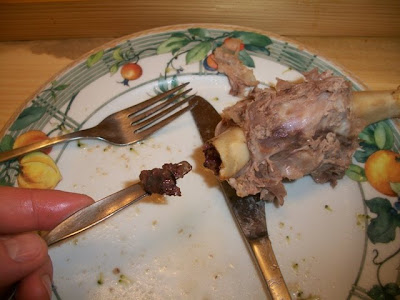
Definitely not one for the restaurant; but worth the effort when you're at home.

Second, from chicken leg bones. Having boiled chicken bones to make soup and separated the bone out , I once wondered whether I could increase the nutritional value of the soup by breaking open the bones and squeezing out the marrow into the soup mixture. This I did with the help of some pliers . It was quite an effort.

Later, I realised this was not necessary because instead I could simply...
...Eat the Bones
The arrival of the slow cooker meant we were cooking the bones for 8 hours or more. I noticed that when I was removing bits of meat from the bones with my hands, the bones would sometimes crumble. So I tried eating one - and lo, it was good. The texture was crumbly - rather like the bones in tinned salmon or sardines. It felt fine to eat them.
Here are a couple of fine, recent meals I made of complete slow-cooked chicken carcasses . There was nothing left at the end. The middle parts of the larger bones were a little harder to chew, but this only applied to one or two.

I've only ever eaten chicken bones. It may be equally possible with the other animals we roast but I've not tried yet.

Anyway, you won't be surprised to learn this is a step too far for Mrs M. However, recently I introduced bones to her diet by stealth, by making...
...Soup and Bones Together
When the bones are this soft, you can throw them into the blender. The result is a soup that requires no thickening. With the standard coconut cream and tomato puree base it makes pretty good eating. Depending on your tolerance for crunchy bits, you may wish to do more blending than me. I was happy with a 60-second blast but Mrs M was driven to return hers to the blender for a further three 60-second blasts and was still not entirely happy.
Feathers?

I am convinced feathers are coming into fashion any day now. I just need to convince my boss and my social circle of this, then I can truly make the most of poultry ;-)

See Also:
Making the Most of Animals: Part 1 - Wonderful Offal
Making the Most of Animals: Part 2 - Glorious Fat
... Read more

Sunday, 20 December 2009

Making the Most of Animals: Part 2 - Glorious Fat

In part 1 I talked about the importance of eating the meat from animals that have been well treated. Quite apart from any ethical consideration, the fact is it's better for you.

I also mentioned the cost benefits of including offal in your carnivorous repertoire - first, because bought separately it's very cheap, and second because if you bought the whole animal in the first place, you are getting more food for your money.

The same arguments apply to another part of the animal people routinely squander - the fat.

For example, when you buy a lamb chop, very often there is a fairly thick rind of fat on it. This probably contains more calories than the meat (as most of you know, fat has 9 cals/g whereas carbs and protein has 4) - but how healthy that fat is depends very much on how the animal was reared.
Quality Matters
As I wrote in part 1, it's not wise to compromise to eat the fat from industrially farmed animals: they are fed with food like corn and wheat, and kept in unnatural conditions, as a result of which their fat contains more omega 6 and less omega 3 than wild or free-range animals. Eating the fat from such meat is probably not very good for you, though ironically this is not for the reasons the sat-fat-heart brigade claim.

Some Photos of My Fatty Meals

Pork scratchings

Chicken skin

Lamb fat

Duck skin
They key point: fat from free range, organic, or pastured animals is actually good for you.
Eating the Fat Makes the Meat Cheap
Another irony lies in people's tendency to avoid buying organic, pastured or free-range meat because of the cost. Very often these same people can be seen scraping the fatty offcuts into the bin after a meal or carefully separating the skin from a duck or chicken leg.

The point is that if they bought high quality food, and therefore were able to eat all of the serving, they would need less to be satisfied because of the additional calories from the fat - and it would taste nicer too.

When Mrs M and I buy a small organic chicken, it makes up to four meals. There are all kinds of fatty parts to the animal, many of which become crispy if cooked properly. Personally, I am happy to guzzle the fatty parts whether crispy or not, so I can be satisfied by a much less meat than I would otherwise need.

A £10 organic bird therefore means £2.50 per meal. If we bought a crappy, industrially farmed bird for £5 we'd have no choice to but to avoid the fat, so the cost would be the same because we'd only get two meals out of it.

As an aside, I do appreciate some people may be getting their meals for £1.25 because they eat all of the chicken, in spite of the conditions it was raised in, and that for some this is the only way they can afford to live.
Conditioned Avoidance
We have been conditioned to cut the fat off our meat.

The diet-heart hypothesis - the idea that eating saturated fat leads to heart disease - is so thoroughly entrenched in the psyche of most people that there is an instinctive urge to avoid conspicuous animal fat.

I won't bore you with the science here, but regular readers of the blogs in my blog roll will know this is a notion that's being quietly and systematically demolished by authors, commentators and researchers, leaving an ever-dwindling group of establishment die-hards holding aloft a tattered flag.

Even Mrs M, now a fully paid up Paleo queen, cuts the fat off meat when it's not crispy or when there is what she perceives to be 'just too much of it.' As for my Mum and Dad, who themselves have been Paleo for some time, it took them quite a while to get used to the idea that fat is good.
The Power of Indoctrination
What gets me is that nobody wants to leave the crispy skin from a chicken breast. I don't know many people who'd pass up a pork scratching (albeit accompanied by ooh, I shouldn't) and the crispy fat from a lamb or beef steak is surely divine.

Yet the same people who seem unable to exercise the willpower necessary to stop eating sugar, cakes or chocolate, appear suddenly to have this iron resolve when it comes to animal fat. As I recall, I was just the same some years ago. I guess this is testament to the power of indoctrination. No one wants to die. You die of heart attacks. We are told fat gives you a heart attack. I don't remember anyone ever saying that about sugar, albeit that it may turn out to be true.
Paleo Subtleties
It would be remiss of me not to mention that there are differing opinions among advocates of Paleo/Primal eating about how much animal fat we should eat. Some say that wild animals are relatively lean and that our liking for fat was naturally regulated when we were evolving by its relative scarcity. Others say we should freely consume it.

I just wing it. For me, variety is the watchword. On some days I eat white fish or offal, which contain relatively little fat anyway - on these days I get most of my fat from olive or coconut oil. On days when I do eat fatty animals I eat the fat freely.

In part 3 - soups and bones. Yes I said bones - you can eat them. Really.

See Also:
Making the Most of Animals: Part 1 - Wonderful Offal
Making the Most of Animals: Part 3 - Beautiful Bones
... Read more